Express Private Offers
Using AI technology to fast-track purchasing and pre-program AWS private offer creation.
Iterative Product Development
Cloud Marketplace
about.
Product Design
Enterprise Product Development
Agentic AI
Incomplete Project
CLIENT:
AWS Marketplace (in-house)
DURATION:
6 months (part-time)
ROLE:
Senior UX Designer
Buy AWS Marketplace products by taking a quick AI agent-powered quiz to receive an Express Private Offer within 12 hours. For sellers, set up the configuration (which includes opt-in rules and special discounts for specific buyers) for your products by using free text fields to generate specifications via AI Agent mode.
I designed the buyer and seller experiences from March-August 2025 to approx. 90% completion. The final feature launched in November 2025.
context.
AWS Marketplace is a curated digital catalog that customers can use to find, buy, deploy, and manage third-party software, data, and services to build solutions and run their businesses.
Examples of listings to buy/sell: security, business applications, machine learning, data, from multiple industries (healthcare, financial services, telecommunications), and more.
Comparative services include Microsoft Azure Marketplace and Google Cloud Platform.
There are currently 2 ways to buy AWS products, each with its own tradeoffs:
Standard, non-negotiated legal agreements that buyers accept directly from the product listing. Pick from pre-existing menu options for units, terms, pricing, and contract lengths.
Advantage: Buyers can quickly get an offer almost instantaneously. Disadvantage: Limited to available options. Sellers find it hard to describe unit pricing, and listed prices are often inaccurate.
A custom quote for a public product listing. Buyer negotiates with the seller for tailored terms, pricing, or contract length.
Advantage: Exact fit for buyer's needs. Disadvantage: Sellers may take days to respond. A final offer might require weeks of negotiation.
What about buyer use cases where public pricing is too basic but a private offer is too heavy? And what about sellers who need to set recurring appointments for every buyer — can we help them address smaller customers without pulling energy from bigger ones?
Introducing a 3rd, in-between offer method that combines the best of both worlds: Express Private Offers

challenges.
This was a 6-month effort during which I worked concurrently on this project + 3 others. I completed 90% of the design before passing it on to a fellow designer to send over the finish line for AWS Re:Invent in November 2025.
Note: I will be highlighting some differences between my 90% complete designs and the final design, as some features were cut because of technical and resource limitations.
A big reason this project was greenlit was because it addresses a company-wide initiative to find key use cases to showcase AI in core functionality.
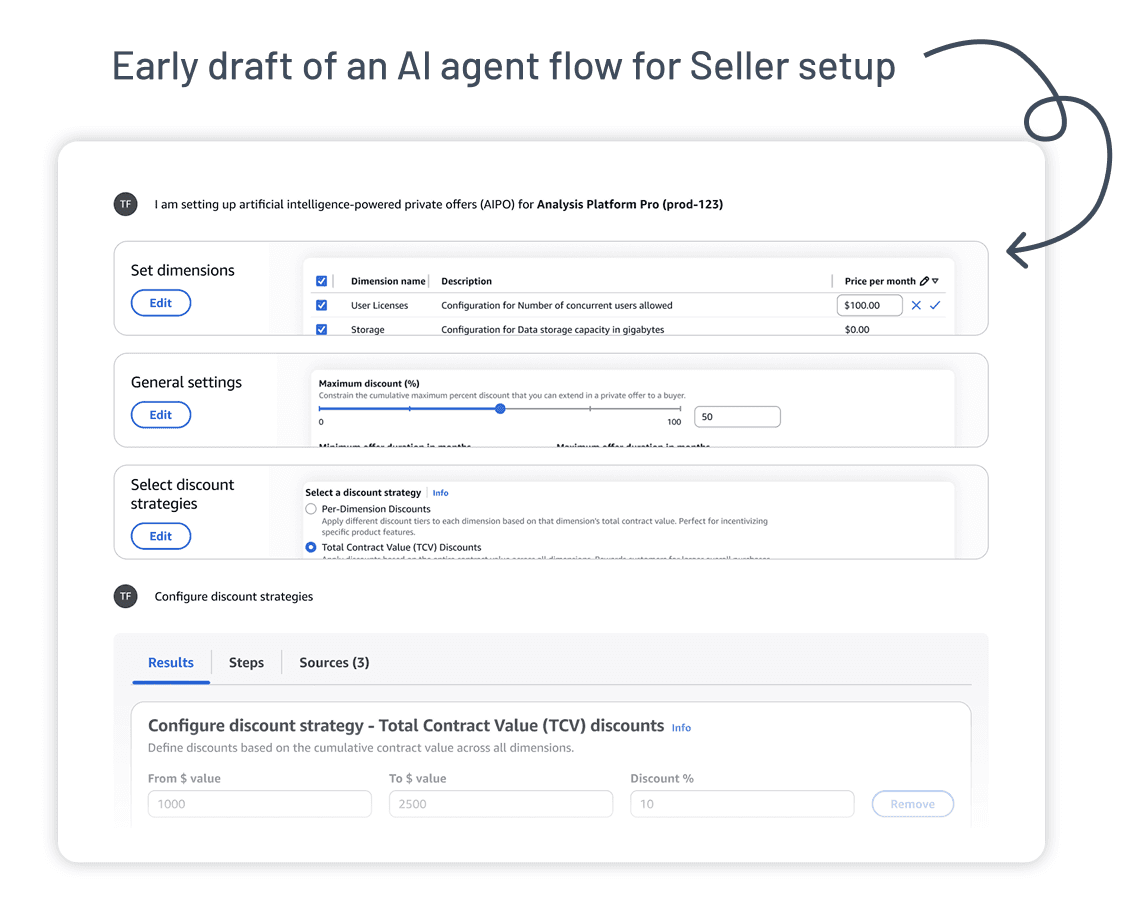
While designing, I looked for any opportunity to fit applications of AI into the buyer and seller journeys, whether it was a more AI-forward overall form factor (see freeform agent concept) or in individual steps.
Despite the company-wide initiative to showcase more AI, we still have plenty of limitations holding us back.
Limitations of current AWS AI implementation: Some proposed applications of AI weren't doable with our current technology.
Limited to AI technology of a parallel feature: both this feature and parallel feature Agent Mode were built at the same time, and tied to the same limitations.
Good old engineering resource shortages: This capability launched at AWS Re:Invent 2025, and certain proposed features were rejected because they would not be completed on time.

research.
Before I started working on this initiative on March 2025, a preliminary design existed as a form for buyers, similar to how Private Offers work today — however, this doesn’t alleviate the buyer/seller pain caused by time used during back and forth negotiation. The only way to change this was to applied a different form factor to this offer method.
I initially conceived of the buyer experience as a basic chatbot/AI Agent and CTA on top of the product details page. Primarily, I wanted to test the effectiveness of the chatbot form factor, but I also used this opportunity to test other elements.
Note: I only had time to test the Buyer experience.
I performed a usability test on initial wireframes for buyers using Figma's presentation mode.
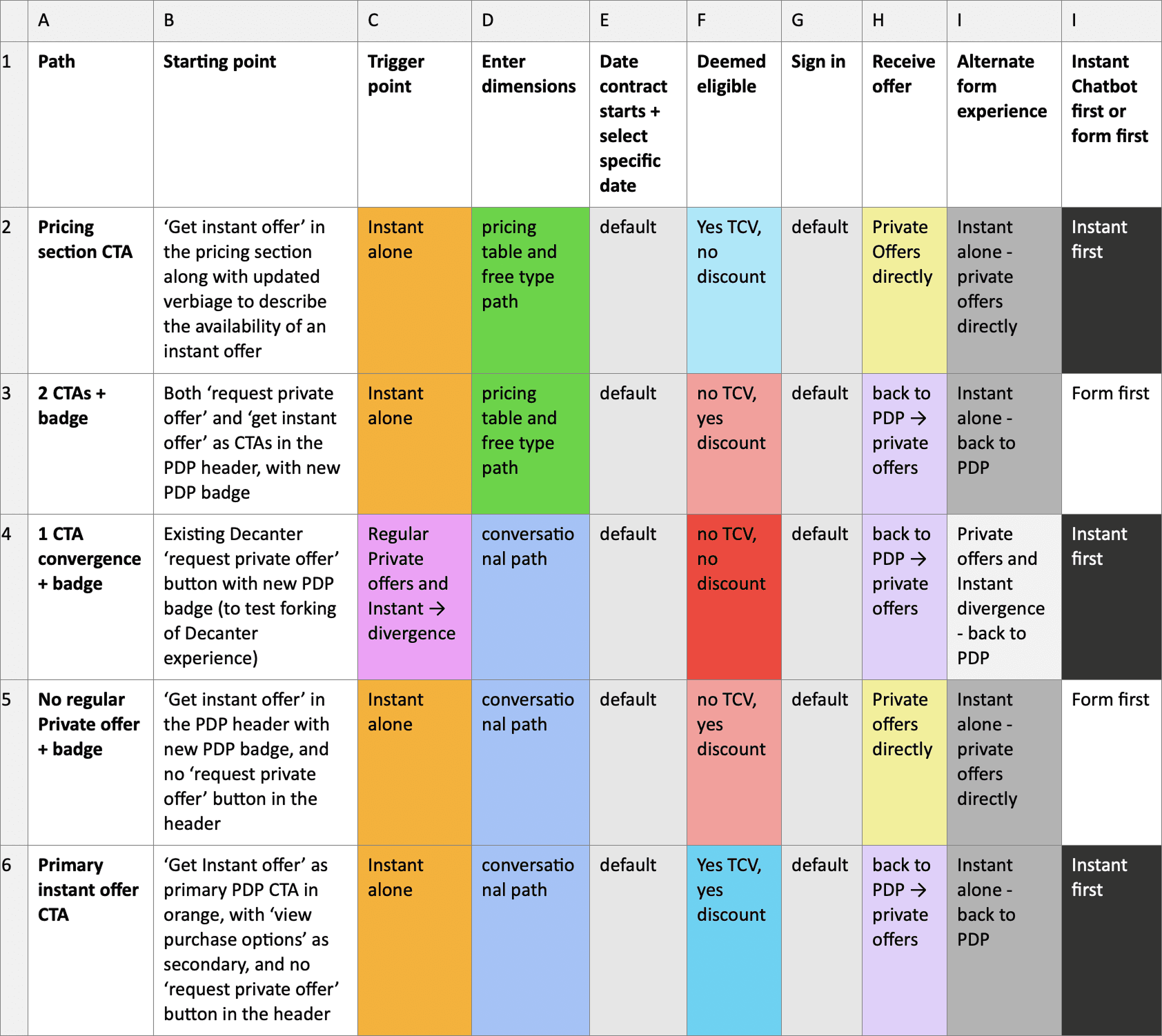
In Figma, I made 5 variations of initial wireframes (plus a simple form version of each variation) that differed in multiple ways (see figure) so I could A/B test multiple factors. To keep track of each change, I color-coordinated my Figma files using a key (see figure).
In addition, I randomized whether the user would see the chatbot version of the buyer experience first or the form version. At the end of the test, I asked which version the user preferred.

I created 1 master document of exact script verbiage for all 5 variations of the test, which I used to copy/paste approx. 45 prompts into each test (x 5 test variations) on UserTesting.com.
I recruited 5 users per test variation by filtering for enterprise AWS users only (and excluding participants from the previous variations of my test) via UserTesting.com's participant recruiting feature, for a grand total of 25 users.
Buyer study results
To process my data, I downloaded the raw verbiage from all 5 UserTesting.com test variations as an Excel sheet, which I annotated and fed into AWS-internal AI engine Cedric (now merged into Amazon Q) to help me summarize.
Some key findings:
Most users preferred the form implementation because they could understand how many more they needed to complete. However, they were intrigued by the AI agent (especially if they weren’t familiar with the processes).
Cloudscape inline editing was surprisingly intuitive for users (see figure below)
‘Instant’ was not a good name, as users thought they would instantly get a private offer as soon as they clicked the CTA button.
The more information I gave (ex. TCV, discount %, estimated total price), the more users felt confident proceeding.
I asked every user whether they would use this new feature, and 100% said they found it useful and would use it. Promising!

Since users requested more structure than a chatbot, I transformed the form factor into a wizard to add structured steps that users can use to keep track of upcoming steps.
I proposed adding the AI agent presence as a helper in each step, rather than as the main form factor. Trust in AI agents still isn't strong, but we need to introduce its presence to users gradually in order to start earning their trust.
design.
I spent approximately 1 month and 5 iterations (per experience) designing the seller and buyer experiences. After playing with a straight form and a full chatbot form factor, I ended up using a multi-step wizard to frame both the buyer and seller experiences.
During design, I suggested and designed some out-there AI features that ultimately were not implemented <— the company wasn't ready and didn’t have the right resources to make these features happen even though I believe they would help the user. I've been told that some of my proposed features may be implemented in a V2 or V3 in the future, though this has not been finalized.
As I began my design of both the seller and buyer experiences, I became aware of AWS Marketplace's Agent Mode which:
was to utilized as the exact underlying technology that this feature (Express Private Offers) was built on
was being designed and developed parallel to this initiative and would launch the same day.
Not only was this madness, but I was now dependent on Agent Mode's decisions in real time.
In an attempt to align with Agent Mode, I tried and failed to fit the seller experience into a true Agent chatbot experience.

How do I educate buyers on the difference between multiple purchase methods? This is a new in-between method that has a lot in common with both existing methods, so this could get confusing for users.

Unit descriptions lack information
The whole purpose of Express Private Offers is to allow users to get a private offer without handholding from a sales rep. To do this, they need enough information to confidently make decisions. Unfortunately, sellers currently have no incentive to add more information (a chicken-and-egg problem).
I designed an experience that uses AI to suggest additional content to the seller, who is now required to fill out at least a few words in a new description field. Though not required, AI will encourage them to add 2-3 sentences of additional verbiage.

My final designs (August 2025)
Please note: these are my latest updated designs as of August 2025, at approx. 90% finished. Upon leaving my role, I onboarded and handed over my files to another designer, who wrapped the design phase in time to launch the final feature in November 2025.
In this section, I will explain the significance of certain pages and compare/contrast my proposed wireframes vs. what was launched.

Seller part 1 - About Express Private Offer & Enter Units
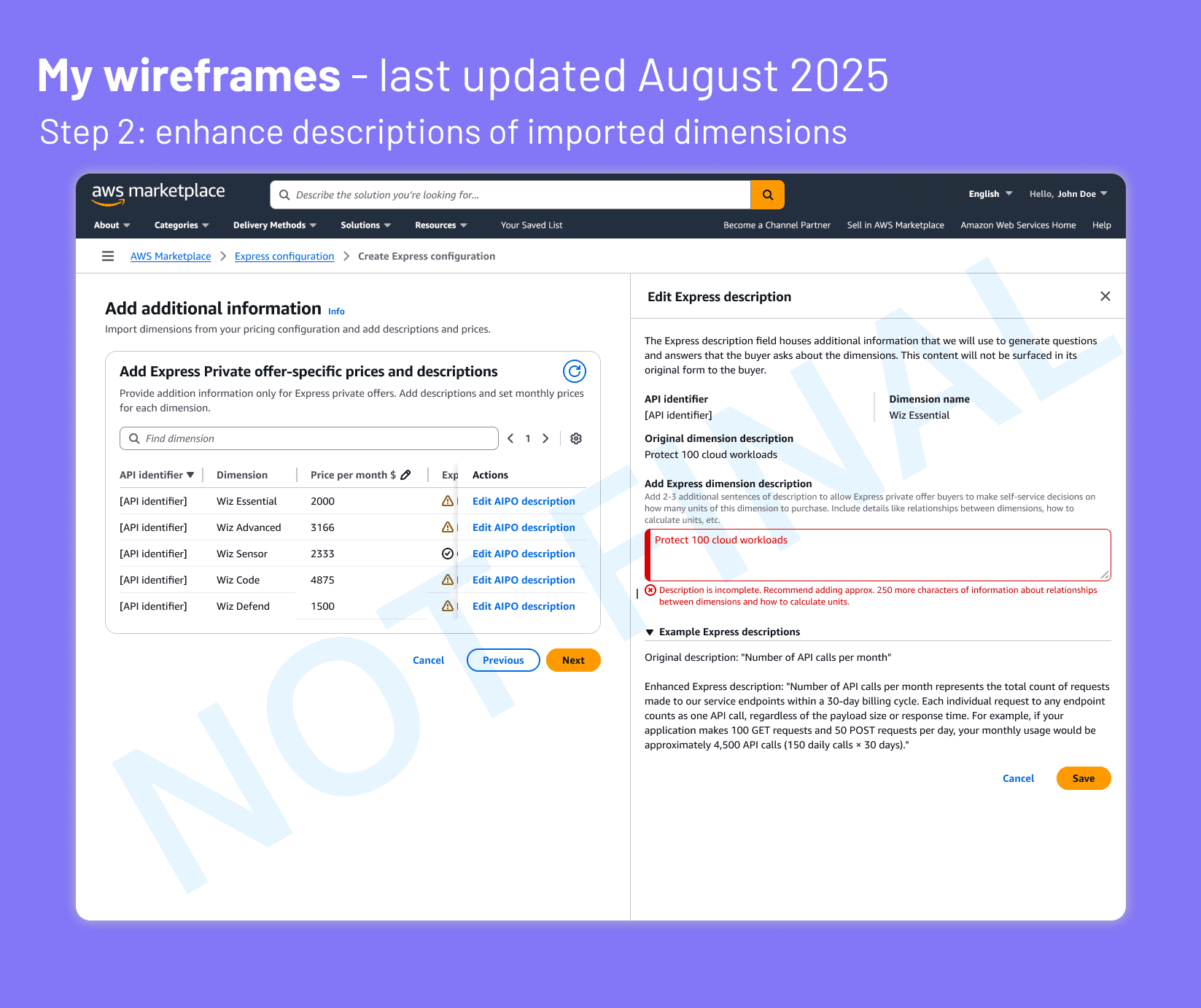
After sellers select their desired dimensions (sub-units of the product) in step 1, they add more details to their dimensions in step 2 for Express private offer users. This is important because these buyers are selecting their units with no representative support (which they get with a custom private offer), so they need to know what they're buying. With the addition of AI agent mode technology, sellers can now use AI support to craft more detailed descriptions.
Differences between original wireframes vs. live feature:
Verbiage became more general (ex. 'Express description' vs. 'Guidance')
Adding a suitably detailed additional description was originally required, but this has changed to a suggestion only

Seller part 2 - Configure Discount Strategy
Step 4 in the seller experience contains the most important settings to Express private offers — the ability to both restrict buyers from qualifying for this type of private offer and also to qualify them for special discounts based on number of dimensions, total contract value, and buyer-entered descriptive values. A seller can select up to 2 discount strategies, and the page will auto-populate subsequent settings based on those selections.
Differences between original wireframes vs. live feature:
No AI agent help for sellers — I initially proposed adding AI agent support for sellers, which was removed.
Additional structure for discount strategy qualifiers — upon adding a qualifier, sellers must select an option from a list of themes. I'm curious where this field came from?


Buyer part 1 - About Express Private Offer & Enter Units
A buyer begins their journey by learning what an Express Private Offer is, why it's different from a custom (regular) private offer, and entering how many units they're prepared to purchase.
Differences between original wireframes vs. live feature:
Merged steps 1 (overview) and 2 (enter units) into a single step. The final design suggests that users did not need as much onboarding information about the new purchase method as initially thought.
Took out much of the information differentiating between regular private offers and Express private offers, adding a graphic and a very brief explanation of the private offer use case ('Connect with representative')
Removed total price calculated during unit entry — this was a conflicted point between Product and me, as Product did not want buyers to game the discount calculation system. My research findings clearly show that all users felt more motivated to continue the process if they are given a semi-accurate total price.
No AI question feature


Buyer part 2 - Contract needs, Questionnaire, and Check eligibility
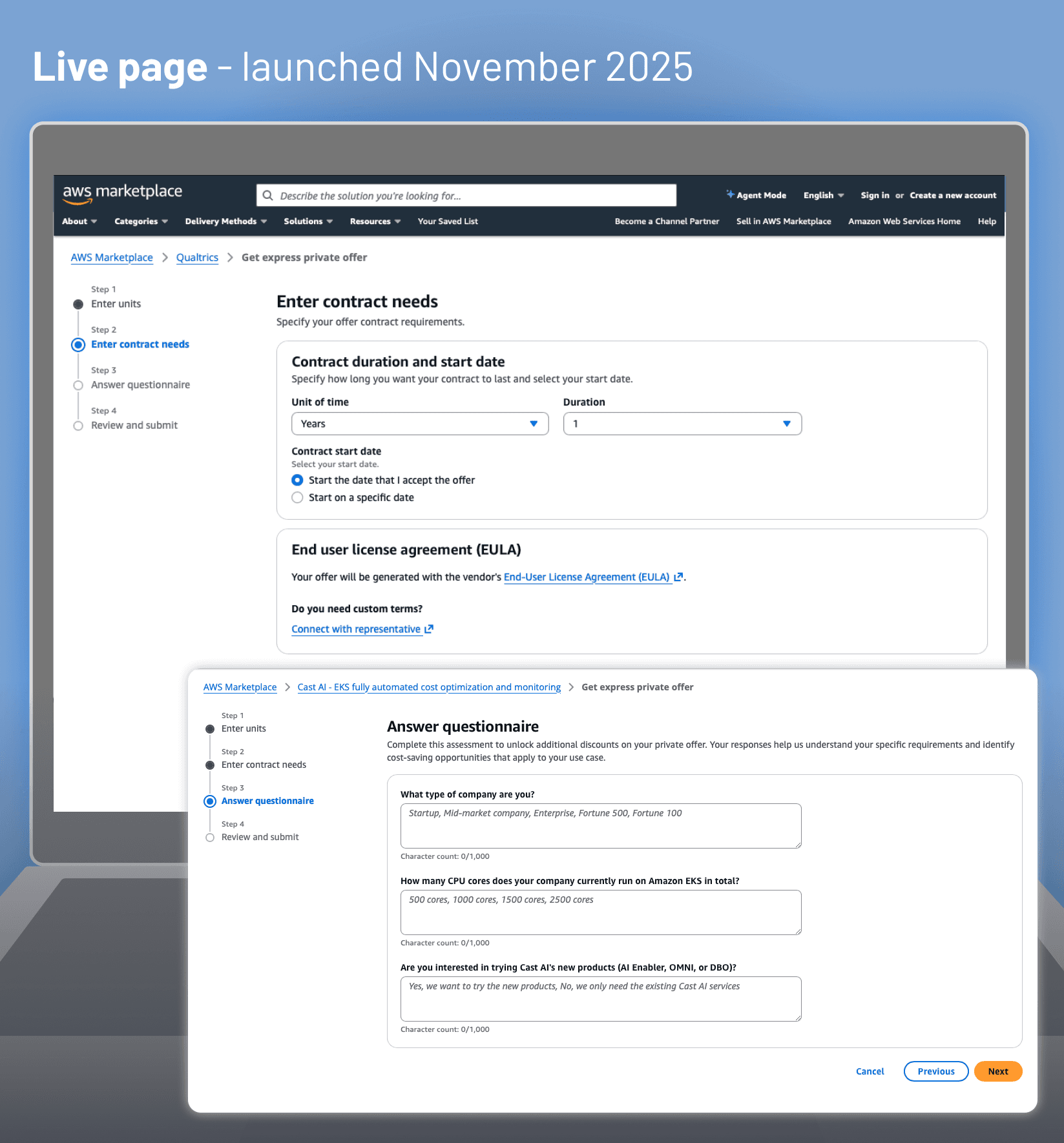
In steps 2 and 3, buyers enter their contract needs and any information about them that they might give a representative. Once they finish entering their information, they can preview what they entered and get the offer.
Differences between original wireframes vs. live feature:
Reshuffling of the contract start date/duration section — the user now inputs their duration before their start date.
New EULA section — I'm curious why this was added, since the user can't take any action here.
No eligibility check step — in the live version, the buyer must complete all the wizard steps, sign in, and only then do they know whether they are eligible.

result.
After 6 months of work and 90% completion, I left the company but not before handing off these wireframes to another designer for last design finishing touches and final handoff processes (sign offs, and fit and finish meetings with design and engineering leadership).
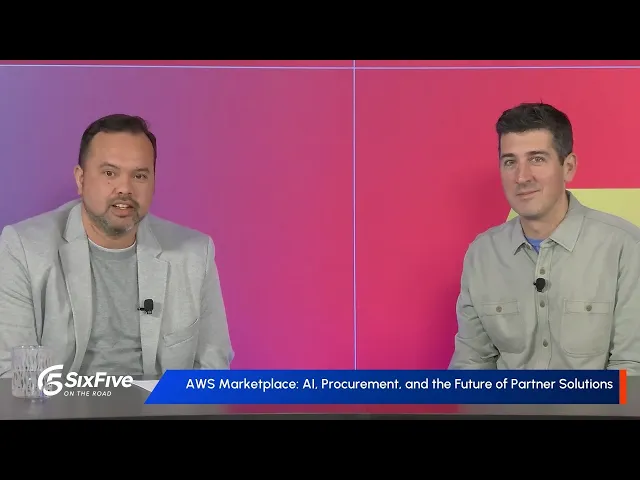
Express Private Offers for AWS Marketplace successfully launched in November 2025 at AWS Re:Invent 2025. Below, AWS Marketplace’s VP discusses the launch and what this feature might mean for customers.
Even without my final touches, this feature launched successfully. These are improvements I would make for future versions:
Perform a usability test with sellers
Advocate for more AI touch points for both seller and buyer
Earlier entry point for seller express private offer configuration
Detect and request for a buyer to sign in earlier than step 5
Reorganize the CTAs on the product details page
Add back the buyer step that clearly stated whether the buyer has qualified or not

learnings.
I am proud of the breadth and depth of work that I contributed, and I'm excited about the adoption of AI in AWS Marketplace!
As of April 2026, adoption of Express Private Offers has taken an unexpected turn: adoption has not increased the rate of new purchases, but resourceful users are now taking the quotes that Express Private Offers generates to gather information between AWS and other competitors.
The next logical step would be to do try-before-you-buy and/or a price-matching program (similar to Best Buy or Amazon.com).
It’s uniquely complicated to launch an underlying technology at the same time that someone else is launching an implementation of that technology. We need to stagger these releases more.
People are more adaptable and creative than we might expect! It's so interesting that they use this new feature in unexpected ways, because their behavior tells us far more than what they might tell us on a business call.
If we really want to go all-in to AI, we need to bake AI into the value proposition. This was an incomplete investment into AI, compromised by inflexible business timelines and engineering resources. Just adding AI isn't necessarily a winning strategy.